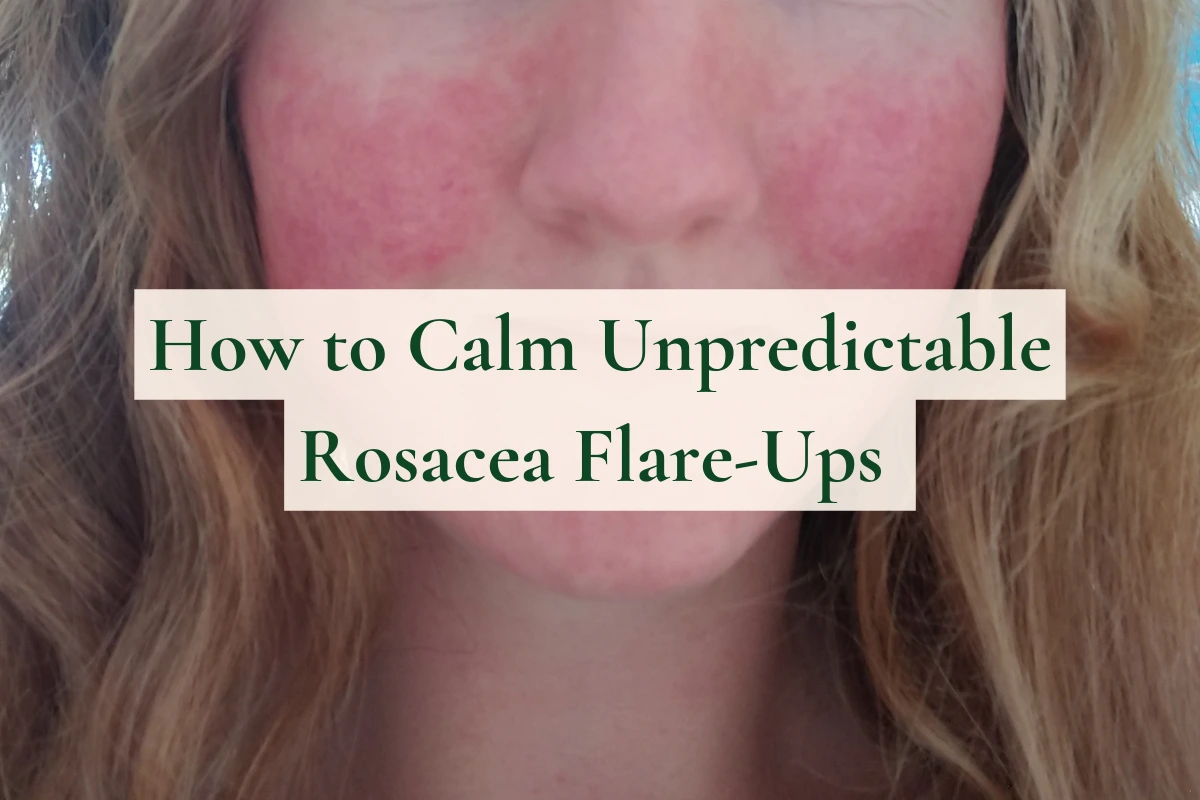
Sometimes the most frustrating part of rosacea can be the unpredictable flare-ups. Particularly when you feel like you are doing everything ‘right’, following your skincare routine, avoiding known triggers, and then out of nowhere your skin decides otherwise.
So, what can we actually do about them? This is why I created this blog post.
Although rosacea flare-ups do become less frequent as we heal and treat rosacea in a natural, holistic way (something I’ve experienced myself over 10+ years), they’re still a part of our lives that we navigate on this journey. Having simple, natural tools and tips to implement in these moments is important and supports the bigger rosacea wellbeing picture too.
There are many things we can do to treat rosacea in a more sustainable way with longer-lasting effects, such as treating the skin barrier, improving gut health, and creating a rosacea-friendly diet and skincare routine. These are the long-term strategies that make the real difference. But what can we do in the moment when a flare-up strikes?
That’s where this post comes in. There are a selection of ideas here. Some will resonate more than others, and that’s absolutely ok. That’s the natural process of so many things in life. Hopefully this is something you can save or bookmark for the moments you need it, a check-in of sorts when your skin is communicating loudly and you need some gentle, practical support.
Post Update:
If you would like a quick-reference version to save and come back to, I have put together a free Rosacea Flare-Up Relief Checklist with all the tools in this post.
Key Takeaways
- Unpredictable flare-ups are not random. Your body is often responding to internal triggers like nervous system activation, digestive stress, or hormonal shifts, which are harder to spot than the obvious ones but just as significant.
- Having practical tools for the moment a flare strikes matters as much as the longer-term healing work. Both have their place, and neither replaces the other.
- How you respond emotionally to a flare-up is part of the physical experience. Frustration and self-criticism can intensify what your body is already dealing with, whilst a gentler pause can genuinely interrupt that cycle.
- Some of the most effective in-the-moment techniques are surprisingly simple. Cooling your pulse points, adjusting your layers, or noticing your breath can calm things faster than you might expect.
- Your personal flare-up toolkit will look different to everyone else’s. The goal is to explore what feels accessible to you, in different environments and different moments, rather than doing everything ‘perfectly’.
Why Rosacea Flare-Ups Feel So Unpredictable
Understanding why flare-ups feel so random can actually help us respond to them more effectively. The truth is, rosacea triggers aren’t just external things like spicy food or weather changes. There’s a whole internal landscape at play too, involving your nervous system, digestive system, hormones, and stress levels.
Sometimes what looks like an unpredictable flare-up is actually your body responding to something you might not immediately connect. Perhaps your sleep has been disrupted, or you’ve been running on adrenaline for days, or your digestive system is processing something it finds challenging. These internal triggers can be harder to spot than the obvious external ones.
This is where the holistic approach I work with becomes really valuable. As we address underlying causes and support our body systems over time, those seemingly random flare-ups do become less frequent and less intense. But whilst we’re on that healing journey, having practical tools for the moments when your skin flares is essential.
6 Natural Ways to Calm a Rosacea Flare-Up
These are practical techniques you can reach for when a flare-up happens. Some work instantly, others might take a few minutes to notice the effects. Try what feels accessible to you in the moment.
TIP 1
Use Gentle Breathing to Calm Your Nervous System
When a flare-up strikes, one of the simplest yet most effective things you can do is notice your breath. Not changing it, not forcing it into a particular pattern or technique, just noticing it as it is.
I know for some people (including me), structured breathing exercises can actually add more stress to an already reactive nervous system. So instead, I invite you to simply observe your natural inhale and exhale without trying to control it.
How to do it:
- Find a comfortable position, sitting or standing
- Notice the natural rhythm of your breath
- Observe where you feel the breath in your body (chest, belly, nose)
- Allow your breath to be exactly as it is
Adding colour visualisation:
My personal favourite way to enhance this? Colour visualisation. Choose a colour that either comes to mind or that you can see in your environment which feels calming and soothing to you. Picture this colour surrounding you whilst you notice your body breathing.
This can be done with your eyes open or closed, which makes it incredibly practical. You can use this technique sat on public transport, in a quiet space at work, or at home. It’s discreet, accessible, and helps your nervous system begin to settle.
You can also add grounding techniques, such as bringing awareness to your feet or palms, which are away from the facial area where rosacea flares. This combination of breath awareness, colour, and grounding forms the foundation of deeper calming practices.
Why this works:
When we’re in a flare-up, our nervous system is often in a heightened state. By gently bringing attention to the breath without forcing change, we’re signalling to our body that we’re safe. The nervous system can begin to shift from that fight-or-flight response into a calmer state, which in turn can help reduce the intensity of the flare.
Want instant access to a guided audio practice just like the one above? Then my Skin Calm Reset is for and comes as part of my Rosacea Support Essentials.
TIP 2
Cool Water on Pulse Points
Cooling your body temperature can provide quick relief during a flare-up, and one of the most effective ways to do this is through your pulse points.
How to do it:
- Run cool (not ice cold) water on the inside of your wrists for 30-60 seconds
- Or, if you’re at home and feeling brave, run cool water over your feet or toes in the bath or shower
- Allow the cooling effect to spread through your body
Why pulse points matter:
Your wrists are particularly effective cooling spots because the blood vessels sit close to the surface at these pulse points. When you cool the blood flowing through these vessels, you’re essentially helping to lower your overall body temperature more quickly than you might expect from such a small area.
This targeted approach means you can get relief without having to do something more involved, making it perfect for when you’re out and about or at work or need that quicker relief.
Why the feet work so well:
Our body temperature is often regulated by how our feet feel. If our feet are warm, we tend to feel warm overall. If our feet feel cool, our body temperature often follows. This is why cooling the feet can be surprisingly effective for bringing down that flushed, overheated feeling that comes with a rosacea flare.
TIP 3
Apply an Ice Pack or Cold Compress for Quick Relief
This was my go-to technique in my earlier days with rosacea, particularly when the intensity of flare-ups became too much and before I learned other ways to support the bigger picture of my rosacea healing.
Sometimes an ice pack (wrapped in a tea towel or paper towel to protect your skin) was the only thing that would help. What I didn’t realise at the time is that it worked in two ways. It cooled my cheeks from the outside, yes, but it also gave me time to pause and sit still, which helped my nervous system regulate too.
Using an ice pack:
- Wrap an ice pack in a tea towel or paper towel (never apply ice directly to skin)
- Hold gently against the flushed areas for a few minutes
- Take breaks if needed
- Notice the cooling sensation and allow yourself to rest
If an ice pack feels too intense:
A cold compress can be just as effective and might feel gentler on sensitive rosacea skin.
- Run a face cloth under cold water
- Ring out the excess water
- Apply to your face where needed
- Repeat as many times as feels helpful
The beauty of the cold compress is that you can control the temperature more easily and refresh it whenever you need to.
TIP 4
Use Essential Oils to Calm Your System
Inhalation of essential oils is often the most effective and fastest way to benefit. When we breathe in these aromatic scents, they travel through our nasal passages, sending messages to our brain. This is why aromatherapy can influence both our emotional wellbeing and our physical responses, including helping to calm an activated nervous system during a rosacea flare.
At home:
- Apply a few drops of essential oil to a tissue or cotton wool
- Hold near your nose and inhale gently
- Breathe naturally, no need to force deep breaths
- You can keep the tissue in your pocket so the scent stays with you throughout the day
When you’re out and about:
Flare-ups often happen when we’re away from home, at unpredictable times (which is what this post is all about, after all). Having a pre-made blend in your bag that you can inhale when needed can be incredibly reassuring.
Essential oils to consider:
These oils are particularly gentle and supportive for calming both skin and nervous system responses:
Frankincense or Vetiver – Grounding, earthy scents that help settle an overactive mind and bring you back into your body. Frankincense has a warm, slightly woody aroma, while Vetiver is deeper and more grounding.
Chamomile or Lavender – Classic calming oils with gentle, soothing properties. Both have soft, floral scents that most people find comforting. Chamomile is particularly known for its anti-inflammatory benefits, and Lavender for nervous system support.
Sweet Orange or Mandarin – Uplifting citrus scents that can help shift your mood without being overstimulating. Both are gentle, sweet, and can bring a sense of lightness to a stressful moment.
How to use essential oils safely:
For inhalation, place 1-3 drops, of one or two oils, on a tissue or cotton wool and breathe in gently. This method allows you to benefit from the oils’ properties without any contact with your skin.
Disclaimer: If you are pregnant, breastfeeding, have a medical condition, or are taking medication, please speak to your healthcare provider before using essential oils.
TIP 5
Remove Layers and Get Fresh Air
This may seem simple, however it’s something that can be easily overlooked when you’re in the middle of a flare-up. If you start to feel a flare coming on or are already experiencing one, stop and review what layers you have close to your face and neck.
Are you wearing a scarf? A big jumper? A hat? These items are more than likely trapping heat in your body and making you feel that extra bit more flustered than you need to be. Consider whether you’re able to remove the scarf or loosen your clothing around your neck, to help your body cool down.
A lesson I learned:
After having bad laryngitis, my throat used to feel cool and needed extra warmth and protection, so I wore a lot of scarves, even indoors. However, amongst other changes I was making, I realised that being so wrapped up and keeping extra warmth in my body really wasn’t helping my rosacea. I learned from this that it’s good to check in with my body and help my body temperature regulate.
It might not be obvious that you’re feeling stuffy, particularly if you’re someone who feels the cold. However, it’s beneficial for everyone’s wellbeing to change over the air in a room regularly and get some natural fresh air into our lungs and bodies.
Quick environment checks:
- Can you remove a layer (scarf, jumper, cardigan)?
- Can you move to a window or open one?
- Can you change rooms to somewhere cooler?
- Can you step outside briefly for fresh air?
Tip 6
Apply Cooling Natural Ingredients
While you’re adjusting your environment, this is also a good moment to consider gentle topical support. When I had side effects to rosacea antibiotic cream I was prescribed, aloe vera was my go-to at the very beginning of my rosacea journey.
When applying topical treatments for rosacea, I personally stay with the principle of natural and as pure as possible. What does this mean? For me, it’s something I can identify as having a plant source. Take aloe vera, for example. At one point I had an aloe vera plant and intended to use the gel directly from it (although the plant unfortunately didn’t flourish in my environment). The principle stands though – if I could use something directly from a plant, without any extra ingredients, or if it’s something we can safely eat, it will generally be ok for rosacea skin. Of course, there are exceptions to every rule.
Cucumber is another good option. It has naturally cooling and hydrating properties, and you probably have it in the refrigerator already.
Why this approach:
In times of rosacea flaring, it’s best not to try a new product or something with multiple ingredients. Instead, focus on these simple natural food or plant sources that your skin is less likely to react to.
I know there are other plant-based, natural topical remedies mentioned in the rosacea community, such as oatmeal. However, I’ve never tried these methods myself, so I can’t recommend anything I haven’t personally experienced.
Bonus Tip
Avoid the Stress Spiral During a Flare-Up
Don’t get frustrated. Easier said than done, right? I know the feeling well. When someone says ‘well, just calm down’ it’s incredibly unhelpful, and honestly, it often has the opposite effect.
Here’s why this matters more than you might think. By getting frustrated, cross, annoyed, stressed, or even panicked about the flare-up, you’re signalling more danger to your body. This activates your fight-or-flight response. The more we have that inner dialogue of putting ourselves down, getting frustrated, or letting the inner critic takeover when a rosacea flare-up occurs, the more we’re creating internal friction and adding to what our body is already dealing with.
Within the mindfulness space, adding more pain, or in the case of rosacea adding emotional pain, is termed ‘the second arrow’. The Buddha described it this way – the first arrow hurts, so why do we shoot the second arrow into ourselves? And yet we do. He goes on to say that in life, we cannot always control the first arrow. However, the second arrow is our reaction to the first. The second arrow is optional.
How this translates for rosacea flare ups.
We may not be able to always ‘control’ the pain/discomfort of a rosacea flare up however we can change and reframe how we approach these moments when they do arrive.
This may sound like a lot when you read it, however the mind and body work really quickly through these processes. So much happens on a subconscious level, at a pace we don’t consciously recognise.
What you can do instead:
Instead of the stressed, panicked, frustrated reaction, wanting the flare to disappear as quickly as possible, you can explore pausing and noticing.
Try asking yourself:
- “Ok, this is a rosacea flare-up happening right now”
- “This is probably my body trying to communicate something”
- “What would I say to a friend in this moment?”
- “What do I need right now?”
This process can help break the cycle mentioned above. It’s also a valuable practice to explore away from a rosacea flare-up, which allows this inner resource to be more accessible when you’re in more acute situations. Admittedly, this can be harder to accept/implement when we’re in a moment of self-survival, which is why gentle practice matters.
TIPS SUMMARY
These six approaches give you options when a flare-up strikes. You don’t need to use all of them, and you certainly don’t need to use them perfectly. The goal is to have a selection of tools you can reach for depending on where you are, what feels accessible, and what your body needs in that particular moment.
Some of these techniques work within seconds, others take a few minutes to notice the shift. Some require you to be at home, others you can do discreetly anywhere. Build your own toolkit from what resonates with you.
Want to keep these tips somewhere handy? Download your free Rosacea Flare-Up Relief Checklist and have it ready for the next time your skin flares.
Understanding What Triggers Your Rosacea Flare-Ups
While the tips above help you respond in the moment, there’s also value in paying attention to what your flare-ups might be communicating over time.
Your body isn’t flaring randomly just to frustrate you (even though it can feel that way). Flare-ups are often your body’s way of signalling that something needs attention. This might be related to your gut health, skin barrier function, hormone balance, stress levels, or various other interconnected systems in your body.
This is where addressing underlying causes becomes valuable.
When we support the skin barrier, work on improving gut health, create a rosacea-friendly diet and skincare routine, and look at the bigger picture of our wellbeing, those unpredictable flare-ups genuinely do become less frequent and less intense.
I’ve experienced this myself over my 10+ year journey with rosacea. The difference between where I started and where I am now, in terms of flare-up frequency and severity, is significant. Not because I found a magic cure, but because I addressed multiple aspects of my health and wellbeing in a holistic, sustainable way.
The practical tools in this post support you in the immediate moments. The deeper work supports your long-term healing. Both matter, and both have their place in your rosacea journey.
Creating Your Personal Flare-Up Toolkit
As you work with these approaches, you’ll start to notice which ones resonate most with you and which feel most accessible in different situations.
Perhaps the breathing and colour visualisation becomes your go-to when you’re out in public. Maybe the ice pack is what you reach for at home when things feel intense. You might find that checking your layers and getting fresh air works surprisingly well, or that the self-compassion questions help you shift out of that frustrated spiral.
There’s no right way to use these tools. The goal is to experiment, notice what helps, and build your own personal toolkit that feels authentic and accessible to you.
Pay attention to patterns over time.
- What tends to help most?
- What feels manageable even when you’re stressed?
- What can you do in different environments?
This awareness helps you feel more prepared and less caught off guard when a flare-up happens.
Closing Reflections
Managing unpredictable rosacea flare-ups isn’t about having perfect control or never experiencing them again. It’s about having gentle, practical tools you can reach for when you need them, and understanding that your body is communicating with you rather than working against you.
As you continue on your rosacea journey, these immediate relief strategies work alongside the deeper healing work of addressing root causes and supporting your overall wellbeing.
If you’re looking for more structured support in understanding your rosacea triggers and patterns, my Rosacea Support Essentials includes guided resources to help you tune into your body’s signals and create your own personalised approach to rosacea wellbeing.
Remember, healing isn’t linear, and flare-ups don’t mean you’re doing anything wrong. They’re simply part of the journey, and having compassionate, practical tools to support yourself through them makes all the difference.
What’s your top go-to in a rosacea flare-up? Please feel free to let me know, I enjoy hearing from readers.
FAQs
Why does my face keep going red for no obvious reason?
Facial redness that seems to appear without warning is often linked to internal triggers rather than obvious external ones. Your nervous system, digestive system, hormones, and stress levels all play a role. What looks like a random flare is frequently your body responding to something less visible, like disrupted sleep or sustained pressure.
Why are rosacea flare-ups feel so random and hard to predict?
Rosacea flare-ups feel random because they are not always triggered by the obvious things. Internal factors like your stress levels, gut health, hormonal shifts, and nervous system state all contribute. Once you start recognising this internal landscape alongside external triggers, the patterns often become clearer and easier to work with over time.
What is the fastest way to calm a rosacea flare-up?
Cooling your pulse points with cold water is one of the quickest options. Running cool water over your inner wrists for 30 to 60 seconds helps lower your overall body temperature because blood vessels sit close to the surface there. It works quickly and easily, making it practical whether you are at home or out.
Can breathing exercises actually help during a rosacea flare-up?
Gentle breath awareness can genuinely help. Rather than forcing a structured breathing technique, which can add more stress, simply noticing your natural breath without trying to control it signals safety to your nervous system. Combining this with a calming colour visualisation makes it even more effective and is something you can do pretty much anywhere.
What should I put on my face during a rosacea flare-up?
During a flare, simple is best. Aloe vera gel or chilled cucumber slices are gentle, natural options that cool and soothe without adding unnecessary ingredients. Avoid trying new products when your skin is already reactive. If something has a plant or food source and is as pure as possible, it is generally safer to use.
Does stress make rosacea flare-ups worse?
Stress can trigger a flare and then the flare causes more stress about your appearance, creating a difficult cycle. Getting frustrated or self-critical during a flare actually signals more danger to your body, intensifying the response. Pausing to ask what your body needs in that moment can gently interrupt that pattern rather than deepen it.

0 Comments
Trackbacks/Pingbacks