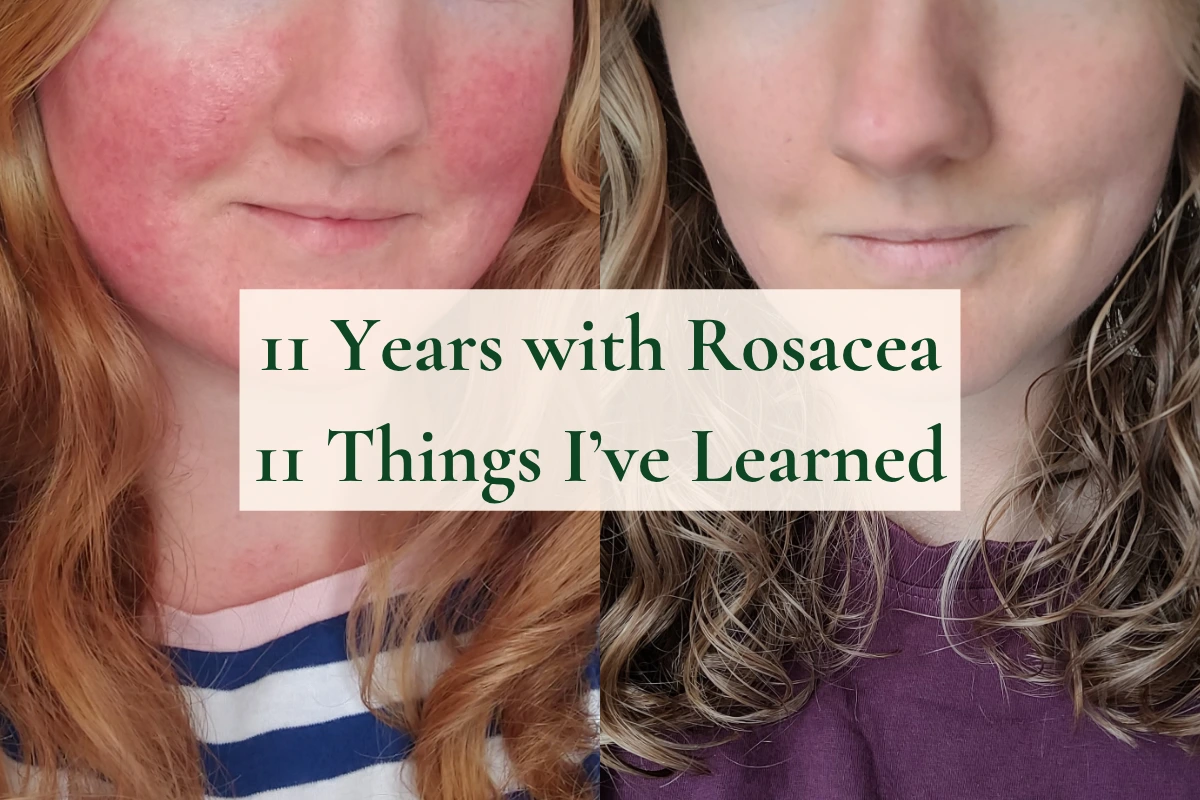
Living with rosacea for eleven years teaches you things no GP appointment or skincare label ever could. This post brings together the most meaningful of those lessons, from understanding what rosacea actually is, to the emotional side that rarely gets talked about, to what my skin looks and feels like now.
Each of the eleven points below stands on its own. You do not need to read in order. Start with whatever feels most relevant to where you are on your journey right now.
Approaching rosacea awareness month and eleven years since my own symptoms first appeared felt like the right moment to write this. Not as a before-and-after story, but as an honest map of what I have learned, what shifted my thinking, and what I wish I had known sooner.
Disclaimer: The content in this post reflects my personal experience and holistic training only. It is not medical advice. Always consult a qualified healthcare professional before adjusting any prescribed treatment plan.
1. Rosacea Is Not Just a Skin Condition
Once I understood this, everything else on my journey started to make more sense. For years I had been focused entirely on my face, trying to fix what I could see, not realising that what was showing up on my skin was often a signal from somewhere else in the body entirely. The moment I stopped treating rosacea as purely a skin problem and started seeing it as part of a bigger, whole-body picture, the way I approached everything changed.
If you have ever felt like you are managing symptoms but not really getting anywhere, this might be why.
Something to consider
Rosacea does not exist in isolation. Our body systems, digestive, nervous, circulatory, immune, do not operate independently of one another. What is happening in one area influences what is happening in another. So when the gut is inflamed, or the nervous system is under pressure, or emotions are running high, the skin can reflect that. For rosacea, that reflection tends to show up on the face. Understanding this was not discouraging for me, it was actually the opposite. It opened up a much wider, more useful set of questions.
Relevant post: My Journey to Managing Rosacea Naturally
2. How Stress Shaped My Rosacea
Looking back, stress was there from the beginning. The period when my rosacea first appeared was one of the more pressured times in my life, and while I was aware of that at the time, I did not fully appreciate how much it was contributing to what was happening on my skin. It sat in the background of my journey for years, something I acknowledged but never really stopped to look at properly.
That might resonate if stress feels like such a constant in your life that it barely registers as a variable anymore.
Something to consider
The tricky thing about stress and rosacea is that stress is not always dramatic or obvious. It is not only the big, difficult moments. Moving house, a holiday, a busy season at work, anything where demand outpaces your available time and energy can put the body under pressure. What I found useful was not trying to eliminate stress, which is neither realistic nor the point, but looking at how I was relating to it and what I was doing to support my nervous system alongside it. That shift, from trying to remove stress to learning to work with it, made a quiet but significant difference over time.
Relevant post: Rosacea When Stressed: Is This the Hidden Trigger Most Treatment Plans Miss?
3. Why Rosacea Triggers Are Rarely Just One Thing
For a long time I was looking for the trigger. The one thing I could identify, remove, and feel confident that I had solved something. I kept a mental list, revisited it regularly, and hit a wall just as regularly. It was frustrating in a way that is hard to describe, because the answer always felt just out of reach.
If you have been on the rosacea journey for any length of time, that probably sounds familiar.
Something to consider
What changed things for me was letting go of the idea that there was a single culprit to find. Triggers tend to be cumulative and there are many factors that can trigger rosacea.
Think of it like a bucket that fills gradually throughout the day or the week. Stress, tiredness, a particular food, a change in temperature, a new product on your skin. Individually, any one of those might be fine. Together, or in the wrong combination at the wrong moment, the bucket overflows.
Once I started thinking in combinations rather than causes, the whole picture became easier to read and, oddly, less stressful to navigate. I was not chasing one answer anymore. I was learning to notice patterns instead.
Relevant post: How to Calm Unpredictable Rosacea Flare-Ups (6 Natural Tips)
Free resource: Rosacea Connection Tracker
4. How Gut Health and Diet Affect Rosacea More Than I Realised
I always had a general sense that food and digestion were connected to overall health, but when it came to rosacea specifically, I was only seeing part of the picture. I knew diet played a role, the way it does with most things, but I had not yet understood just how directly the gut was influencing what was showing up on my face. That connection, once I really started to explore it, turned out to be one of the most significant pieces of the whole puzzle.
You might be wondering what the gut has to do with a skin condition on your face.
Something to consider
The answer lies in something called the gut-skin axis, a communication pathway between the digestive system and the skin. Put simply, when the gut is inflamed, imbalanced, or missing the building blocks it needs to function well, that disruption can show up on the skin.
For rosacea, that often means increased redness, sensitivity, or flare frequency.
For me, discovering a sensitivity to gluten, working on rebuilding good gut bacteria, and looking at low stomach acid were all part of gradually shifting my baseline. An anti-inflammatory approach to eating, combined with supporting the gut microbiome, made a noticeable difference over time. Not overnight, but meaningfully and cumulatively.
Relevant post: Rosacea Foods to Avoid (But What You Can Actually Eat)
Relevant post: Is Rosacea Linked to Gut Health? What I Learned from Probiotics, Gluten and AIP
5. My Emotions Were Showing Up on My Skin
This one took me a while to sit with. The idea that my emotions were not just influencing my rosacea but were actively showing up on my skin felt confronting at first, and then, once a homeopath helped me see it differently, genuinely useful. Rosacea became less of a random enemy and more of a signal. A small white flag from my body communicating that something needed attention.
What changed was the way I related to that signal.
Something to consider
The difficult part, early on, was the loop of it. Feeling stressed or embarrassed, watching it appear on my face, and then feeling more stressed and embarrassed as a result. It is not a comfortable cycle to be in. What helped was shifting from trying to suppress or avoid those emotions to simply recognising them, and then asking what kind of support I actually needed in that moment.
Understanding that a particular emotion tends to contribute to a particular outcome does not make you powerless, it actually gives you somewhere useful to start.
Our body systems, as I have come to understand more and more, do not work in isolation. The emotional and the physical are far more connected than I ever gave them credit for in those early years.
Relevant post: Can Rosacea Affect Self-Esteem and Confidence? (And What Actually Helps)
Free resource: Rosacea Connection Tracker
6. When Conventional Rosacea Treatment Felt Limited
My experience with conventional treatment was not a positive one. A topical antibiotic cream prescribed by my GP left me with side effects that felt worse than where I had started, and skincare marketed as suitable for rosacea caused reactions and flare-ups more than once. There was a moment where I genuinely did not know what the next step was, and that felt quite isolating at the time.
Looking back, that dead end was one of the more useful things that happened to me.
Something to consider
Those setbacks pushed me to look in a different direction entirely, towards natural approaches and the underlying root causes that conventional treatment had not really touched.
I want to be clear that this is not about being anti-medicine.
Conventional treatment absolutely has its place, and I would never suggest stopping anything prescribed by a healthcare professional.
But when the conventional route feels like it has taken you as far as it can, or you are looking to add something more to what you are already doing, holistic and natural approaches can work genuinely well alongside it.
Complementary, not instead of. That distinction matters.
Relevant post: Personal Experience Managing Rosacea Symptoms Without Antibiotics
Free resource: Rosacea Flare-Up Relief Checklist
7. What Becoming My Own Health Advocate Actually Taught Me
I did not set out to become my own health advocate. It happened gradually, partly out of necessity and partly out of personality. Over time I found myself piecing together information from different sources, testing things, discarding what did not fit, and slowly building something that felt like my own map of the journey.
If you have ever felt like the advice available is circling what you actually need without quite landing there, you will know what I mean.
Something to consider
Doing this alone carries a real emotional weight. Being your own researcher, your own decision-maker, all at the same time, takes energy that you do not always have spare when you are managing a chronic skin condition.
If I could offer anything from that experience it would be this: ask for help sooner than I did, and find someone who genuinely understands what you are navigating.
The second thing, and perhaps the more important one, is to trust your own instincts. You are the only person who truly knows how your body feels and what does not sit right. That knowledge is worth something.
Relevant post: My Journey to Managing Rosacea Naturally
8. Holistic Therapies Were The Missing Piece
Natural and complementary therapies have been part of my life for a long time, long before rosacea. But training professionally in aromatherapy, reflexology, and colour therapy changed something. Each modality gave me a new lens through which to understand what was happening in my body, and I kept finding myself thinking “oh, that explains it.” The learning and the healing started to inform each other.
That shift, from holistic therapies as a nice addition to a genuine and central part of my approach, opened up options I had not considered before.
Something to consider
Conventional treatment tends to work at the level of the symptom. Holistic therapies, used thoughtfully, can reach the underlying systems where root causes often live. The nervous system, the digestive system, the emotional landscape. Once I started working there, the changes were not dramatic or overnight, but they were real and they accumulated.
Relevant post: What Are Holistic Therapies? and How They Help Chronic Skin Conditions
9. Why Rosacea Skincare Was Only Half the Story
Skincare was one of the most confusing parts of my rosacea journey. I was adding products, following recommendations, trying formulations labelled as safe for rosacea, and getting reactions anyway. At a certain point I stopped using skincare altogether.
That felt like defeat at the time. It turned out to be a turning point.
If you have ever left a chemist aisle more confused than when you arrived, you are not imagining it.
Something to consider
Training as a skincare formulator gave me a clear, evidence-based understanding of what was actually in the products I was using and why certain ingredients were making things worse.
What I learned simplified everything.
For rosacea skin, less is genuinely more. A single well-chosen oil, rosehip seed oil being one I return to regularly, will often do more than a multi-step routine packed with actives.
And as with everything else in this post, what you apply topically is only part of the picture. What is happening inside your body matters just as much.
Relevant post: 5 Rosacea Skincare Ingredients to Avoid and 5 to Use Instead
Relevant resource: Rosacea Skincare Guide to Calmer Skin
10. How Rosacea Affected My Confidence
The impact rosacea had on my confidence ran deeper than I let on, even to myself. The shame and embarrassment of those early years changed how I showed up in social situations, around friends, around family, in places where I could not control the lighting or whether someone might comment on my face. It was exhausting in a way that had nothing to do with the physical symptoms.
Perhaps you recognise some of that.
Something to consider
What I can say honestly is that the internal shift has been just as significant as anything that has changed on my skin.
Understanding rosacea more deeply, knowing what supports it and why, gave me a stable foundation that the early years of confusion simply did not offer.
Becoming comfortable in your skin, internally as much as externally, is not a small thing, and there are genuine tools and approaches that support that process as part of the wider picture.
Relevant post: Can Rosacea Affect Self-Esteem and Confidence? (And What Actually Helps)
11. Healing Is Not Always Linear
Setbacks are part of this journey, just as much as the progress.
I know that is not always easy to hear, but I have found it to be genuinely true. There were approaches that did not work at year one and became exactly right at year five. There were things I tried with full commitment that simply did not land, not because they were wrong, but because the timing was off or my system was not ready. Looking back, I can see that capacity mattered as much as the approach itself.
Perhaps you have felt that too, the willingness being there but the time or energy not quite matching it.
Something to consider
A healing journey does not need to look a certain way.
We are all arriving at this from different places, with different histories, different bodies, and different points on the path. What works for one person at one moment may be completely irrelevant to someone else, or to the same person six months later.
My relationship with rosacea is still evolving, and I have made peace with that. It is less about reaching a fixed destination and more about continuing to learn what your body needs as you change alongside it.
What My Rosacea Looks Like Now
Eleven years in, my skin is in a different place entirely. Day to day it feels calmer, softer, and more settled than I could have imagined in those early years. Flares still happen, but they are infrequent and when they do occur the intensity is nothing like it used to be. Where I would once have rated the physical discomfort close to an eight or nine, it now sits at a two or three, and it passes in minutes rather than hours.
My response to a flare has changed too. Instead of frustration I find curiosity. Something along the lines of “that is interesting, what is my body telling me?” I use rosacea now as a check-in, a prompt to ask whether I am tired, stressed, running too warm, or simply not paying attention to something that needs it.
The physical changes are visible too. Looking back at early photographs, my face was swollen and bunched as well as red. That has settled and softened considerably. On most days, without make-up, I do not think rosacea would be the first thing someone noticed.
I share this not to suggest my experience is what yours will look like, but because in those early years of being told “you just have to live with it,” knowing that a different outcome was possible would have meant a great deal to me.
If you are at a point where you would like some support navigating your own rosacea journey, my one to one mentoring is designed for exactly that. You can discover more about working with me here.

0 Comments